
Restorative Design Engineering Approach
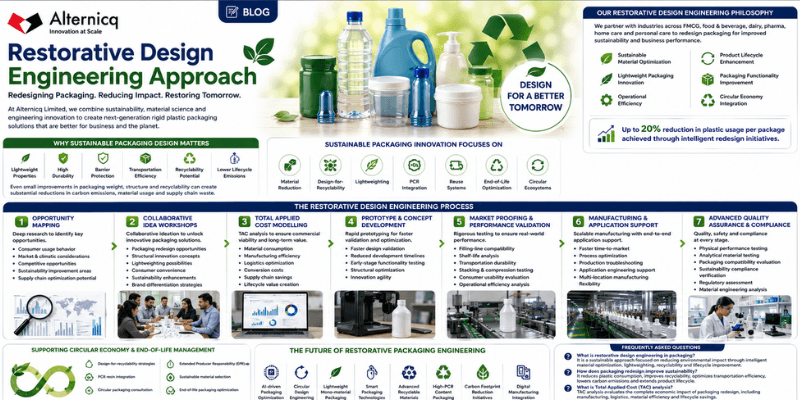
Today’s consumer goods industry demands packaging solutions that go far beyond product containment. Modern packaging is expected to deliver sustainability, operational efficiency, shelf differentiation, material optimization, recyclability, and cost competitiveness — all while maintaining high standards of quality and performance.
Global brands and retailers are increasingly looking for packaging partners that can help them achieve ambitious ESG goals, circular economy commitments, lightweighting targets, and sustainable packaging transformation.
At Alternicq Limited, we believe the future of packaging lies in restorative design engineering — a strategic approach that combines sustainability, material science, packaging innovation, and lifecycle optimization to create next-generation rigid plastic packaging solutions.
Why Sustainable Packaging Design Matters
Plastic packaging continues to play a vital role in modern supply chains due to its:
- Lightweight properties
- High durability
- Barrier protection capabilities
- Transportation efficiency
- Design flexibility
- Recyclability potential
- Lower overall lifecycle emissions
In India, packaging accounts for a significant share of plastic consumption, making packaging redesign and circular design engineering critical to reducing environmental impact.
Sustainable packaging innovation today focuses on:
- Material reduction
- Design-for-recyclability
- Lightweighting
- PCR integration
- Improved reuse systems
- End-of-life optimization
- Circular packaging ecosystems
Even small improvements in packaging weight, structure, and recyclability can create substantial reductions in carbon emissions, material usage, and supply chain waste.
Our Restorative Design Engineering Philosophy
At Alternicq Limited, we collaborate with FMCG, food and beverage, dairy, pharmaceutical, home care, and personal care brands to redesign packaging for improved sustainability and business performance.
Our restorative design engineering framework focuses on:
- Sustainable material optimization
- Product lifecycle enhancement
- Lightweight packaging innovation
- Packaging functionality improvement
- Operational efficiency
- Circular economy integration
Over the years, several redesign initiatives have enabled up to 20% reduction in plastic usage per package while maintaining packaging integrity and shelf performance.
The Restorative Design Engineering Process
1. Opportunity Mapping
Every sustainable packaging project begins with deep design and material research.
This stage focuses on identifying:
- Consumer usage behavior
- Market-specific packaging needs
- Geographic and climatic considerations
- Competitive differentiation opportunities
- Sustainability improvement areas
- Supply chain optimization potential
Opportunity mapping helps identify how packaging redesign can improve both environmental and commercial outcomes.
2. Collaborative Idea Workshops
Innovation is strongest when packaging engineers, designers, and brand teams collaborate closely.
Our ideation workshops focus on:
- Packaging redesign opportunities
- Structural innovation concepts
- Lightweighting possibilities
- Consumer convenience improvements
- Sustainability enhancements
- Brand differentiation strategies
At this stage, multiple packaging concepts and design directions are explored to create differentiated and scalable packaging solutions.
3. Total Applied Cost Modelling
Sustainable packaging must also make commercial sense.
Our Total Applied Cost (TAC) analysis evaluates:
- Material consumption
- Manufacturing efficiency
- Logistics optimization
- Conversion costs
- Supply chain savings
- Lifecycle value creation
This approach helps brands understand the long-term economic benefits of sustainable packaging redesign.
4. Prototype and Concept Development
Using advanced prototyping technologies and 3D printing systems, packaging concepts are rapidly converted into functional prototypes.
This stage enables:
- Faster design validation
- Reduced development timelines
- Improved innovation agility
- Early-stage functionality testing
- Structural optimization
Rapid prototyping helps accelerate packaging innovation while minimizing production disruption.
5. Market Proofing and Performance Validation
Before commercialization, packaging solutions undergo extensive validation studies.
These include:
- Filling-line compatibility testing
- Shelf-life analysis
- Transportation durability assessment
- Stacking and compression testing
- Consumer usability evaluation
- Operational efficiency analysis
Market proofing ensures packaging performs consistently across real-world supply chain conditions.
6. Manufacturing and Application Support
With large-scale manufacturing capabilities and advanced converting infrastructure, Alternicq Limited supports rapid commercialization and optimized production scalability.
Our manufacturing support includes:
- Faster time-to-market
- Process optimization
- Production troubleshooting
- Application engineering support
- Multi-location manufacturing flexibility
Efficient converting systems are essential for scaling sustainable packaging innovation successfully.
7. Advanced Quality Assurance and Compliance
High-performance sustainable packaging requires rigorous testing and compliance management.
Our quality assurance framework includes:
- Physical performance testing
- Analytical material testing
- Packaging compatibility evaluation
- Sustainability compliance verification
- Regulatory assessment
- Material engineering analysis
Dedicated QA specialists, chemists, and material engineers help ensure packaging consistency, safety, and operational reliability.
Supporting Circular Economy and End-of-Life Management
Sustainable packaging design must also consider what happens after product usage.
At Alternicq Limited, we support customers through:
- Design-for-recyclability strategies
- PCR resin integration
- Circular packaging consultation
- Extended Producer Responsibility (EPR) support
- Sustainable material selection
- End-of-life packaging optimization
Our sustainability specialists help brands navigate evolving global regulations, emerging sustainability standards, and circular economy frameworks.
The Future of Restorative Packaging Engineering
The future of sustainable packaging will increasingly be shaped by:
- AI-driven packaging optimization
- Circular design engineering
- Lightweight mono-material packaging
- Smart packaging technologies
- Advanced recyclable barrier materials
- High-PCR-content packaging
- Carbon footprint reduction initiatives
- Digital manufacturing integration
Packaging design is no longer just about aesthetics or functionality — it is becoming a strategic sustainability and business transformation tool.
At Alternicq Limited, restorative design engineering continues to drive innovation across rigid plastic packaging ecosystems, helping brands build scalable, sustainable, and future-ready packaging solutions.
Frequently Asked Questions
What is restorative design engineering in packaging?
Restorative design engineering is a sustainable packaging approach focused on reducing environmental impact through intelligent material optimization, lightweighting, recyclability, and lifecycle improvement.
How does packaging redesign improve sustainability?
Packaging redesign can reduce plastic consumption, improve recyclability, optimize transportation efficiency, lower carbon emissions, and extend product lifecycle.
What is Total Applied Cost (TAC) analysis?
TAC analysis evaluates the complete economic impact of packaging redesign, including manufacturing, logistics, material efficiency, and lifecycle savings.
Why is rapid prototyping important in packaging innovation?
Rapid prototyping accelerates packaging development, improves design validation, and reduces commercialization timelines through early-stage testing and optimization.
How does Alternicq support circular packaging initiatives?
Alternicq Limited supports circular packaging through lightweighting, recyclable packaging design, PCR integration, EPR support, sustainable material innovation, and end-of-life packaging optimization.