
Design Thinking for Plastic Waste Reduction
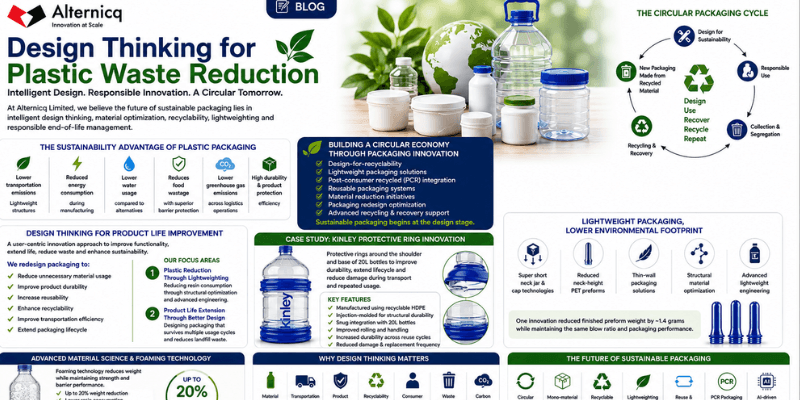
Plastic remains one of the most efficient and versatile packaging materials used across industries today. From food and beverages to healthcare, personal care, dairy, home care, and industrial applications, plastic packaging plays a critical role in product protection, transportation efficiency, hygiene, durability, and shelf-life enhancement.
However, the global conversation around sustainability has shifted the focus from plastic usage itself to how plastics are designed, used, recovered, and recycled within a circular economy framework.
At Alternicq Limited, we believe the future of sustainable packaging lies in intelligent design thinking, material optimization, recyclability, lightweighting, and responsible end-of-life management.
Understanding the Sustainability Advantage of Plastic Packaging
Despite widespread misconceptions, multiple lifecycle assessments (LCA) indicate that plastic packaging often has a lower environmental footprint compared to alternative materials when evaluated across the entire supply chain.
Plastic packaging offers several sustainability advantages:
- Lower transportation emissions due to lightweight structures
- Reduced energy consumption during manufacturing
- Lower water usage compared to many alternative materials
- Reduced food wastage through superior barrier performance
- Lower greenhouse gas emissions across logistics operations
- Higher durability and product protection efficiency
The unique combination of:
- Lightweight properties
- Flexibility
- Barrier protection
- Durability
- Design adaptability
- Reusability potential
makes plastic packaging highly efficient for modern supply chains.
The real sustainability challenge lies not in the material itself, but in improving circularity, recyclability, reuse systems, and post-consumer waste management.
Building a Circular Economy Through Packaging Innovation
At Alternicq Limited, sustainability innovation is focused on enabling a circular plastics economy through:
- Design-for-recyclability
- Lightweight packaging solutions
- Post-consumer recycled (PCR) integration
- Reusable packaging systems
- Material reduction initiatives
- Packaging redesign optimization
- Advanced recycling and recovery support
We believe sustainable packaging begins at the design stage.
Design Thinking for Product Life Improvement
Design thinking in packaging is a user-centric innovation approach that focuses on improving packaging functionality, extending product lifecycle, reducing waste, and enhancing sustainability outcomes.
This process involves redesigning packaging structures to:
- Reduce unnecessary material usage
- Improve product durability
- Increase reusability
- Enhance recyclability
- Improve transportation efficiency
- Extend packaging lifecycle
Our packaging engineering approach focuses on two primary areas:
1. Plastic Reduction Through Lightweighting
Reducing resin consumption through structural optimization and advanced engineering.
2. Product Life Extension Through Better Design
Designing packaging that survives multiple usage cycles and reduces landfill waste.
Case Study: The Kinley Protective Ring Innovation
One of the most impactful examples of sustainable packaging redesign is the protective ring developed in collaboration with Kinley for 20-liter water bottles.
The objective was to:
- Improve bottle durability
- Extend product lifecycle
- Reduce deformation during transportation
- Improve handling efficiency across repeated usage cycles
The solution involved designing protective rings around the shoulder and base of the bottle.
Key Features of the Protective Ring Design
- Manufactured using recyclable HDPE material
- Injection-molded for structural durability
- Designed for snug integration with 20-liter bottles
- Improved rolling and handling during logistics operations
- Increased bottle durability across multiple reuse cycles
- Reduced packaging damage and replacement frequency
The design not only improved operational performance but also supported circular packaging objectives by extending the reusable lifecycle of large-format water containers.
Lightweight Packaging for a Lower Environmental Footprint
Lightweighting is one of the most effective strategies for reducing plastic consumption while maintaining packaging performance.
At Alternicq Limited, lightweight packaging innovation includes:
- Super short neck jar and cap technologies
- Reduced neck-height PET preforms
- Thin-wall packaging solutions
- Structural material optimization
- Advanced lightweight container engineering
One of our lightweight preform innovations reduced finished preform weight by approximately 1.4 grams while maintaining the same blow ratio and packaging performance.
Advanced Material Science and Foaming Technology
Modern material science is creating new opportunities for sustainable rigid plastic packaging.
One such innovation is foaming technology, which enables the reduction of packaging weight while maintaining mechanical strength and barrier performance.
Foaming technology can:
- Reduce container weight by up to 20%
- Lower resin consumption
- Reduce transportation emissions
- Maintain tensile strength
- Preserve barrier properties
These innovations help brands reduce overall environmental footprint while maintaining operational efficiency and product safety.
Why Design Thinking Matters in Sustainable Packaging
Packaging design directly impacts:
- Material consumption
- Transportation efficiency
- Product protection
- Recyclability
- Consumer usability
- Waste generation
- Carbon footprint
Smart packaging design enables companies to move beyond compliance and toward measurable sustainability transformation.
Modern sustainable packaging strategies increasingly focus on:
- Circular economy integration
- Mono-material packaging
- Recyclable rigid packaging
- Lightweighting technologies
- Reuse and refill systems
- PCR packaging adoption
- AI-driven packaging optimization
The Future of Sustainable Plastic Packaging
The future of plastic packaging lies in combining:
- Sustainable material innovation
- Intelligent structural engineering
- Circular packaging ecosystems
- High-performance recyclability
- Lightweighting technologies
- Advanced recovery systems
As industries move toward net-zero goals and circular economy frameworks, packaging design will play a decisive role in reducing environmental impact at scale.
At Alternicq Limited, we continue to innovate sustainable rigid plastic packaging solutions that balance performance, scalability, recyclability, and long-term environmental responsibility.
Frequently Asked Questions
What is design thinking in sustainable packaging?
Design thinking in packaging refers to a user-centric approach focused on improving packaging functionality, reducing waste, enhancing recyclability, and extending product lifecycle.
How does lightweight packaging reduce environmental impact?
Lightweight packaging reduces resin consumption, lowers transportation emissions, improves logistics efficiency, and minimizes overall carbon footprint.
What is foaming technology in plastic packaging?
Foaming technology involves infusing inert gases into plastic materials to reduce density and weight while maintaining structural strength and barrier properties.
Why is reusable packaging important?
Reusable packaging extends the lifecycle of packaging materials, reduces waste generation, and supports circular economy objectives.
How is Alternicq contributing to sustainable packaging innovation?
Alternicq Limited develops sustainable rigid plastic packaging solutions focused on lightweighting, recyclability, PCR integration, packaging redesign, and circular economy innovation across multiple industries.