
Can Packaging Contain Food Wastage at Retail?
Food loss and food waste have become critical global sustainability challenges. According to estimates by the Food and Agriculture Organization (FAO) of the United Nations, nearly one-third of all food produced for human consumption is lost or wasted globally each year — amounting to approximately 1.3 billion tonnes annually. This contributes significantly to carbon emissions, water wastage, and supply chain inefficiencies.
As sustainability, circular economy practices, and responsible consumption gain importance, packaging is increasingly being recognized as a critical enabler in reducing food wastage across the retail and consumer ecosystem.
At Alternicq Limited, we believe packaging innovation plays a vital role in improving shelf life, reducing spoilage, enabling efficient storage, and supporting sustainable food distribution systems.
Understanding Food Waste at Retail
Food wastage at the retail stage is driven by multiple factors, including:
- Poor packaging performance
- Inadequate barrier protection
- Improper temperature management
- Transportation damage
- Exposure to oxygen and moisture
- Inaccurate pack sizing
- Improper storage after opening
- Limited consumer awareness of shelf-life handling
Studies indicate that food wastage levels across supply chains can range between 24% and 40%, making packaging optimization a major opportunity area for brands, retailers, and manufacturers.
Modern sustainable packaging must therefore do more than simply contain a product — it must actively preserve freshness, improve usability, optimize storage, and reduce environmental impact.
The Role of Sustainable Packaging in Reducing Food Waste
Advanced packaging technologies can significantly improve food preservation and reduce losses at both retail and consumer levels.
Effective food packaging solutions help:
- Extend shelf life
- Maintain freshness and taste
- Improve moisture and oxygen protection
- Reduce contamination risks
- Enable efficient transportation
- Improve storage convenience
- Minimize post-opening spoilage
Packaging design today increasingly combines:
- High-barrier packaging materials
- Recyclable rigid packaging
- Lightweight packaging
- Reusable packaging formats
- Sustainable pack-size optimization
- Active and modified atmosphere packaging technologies
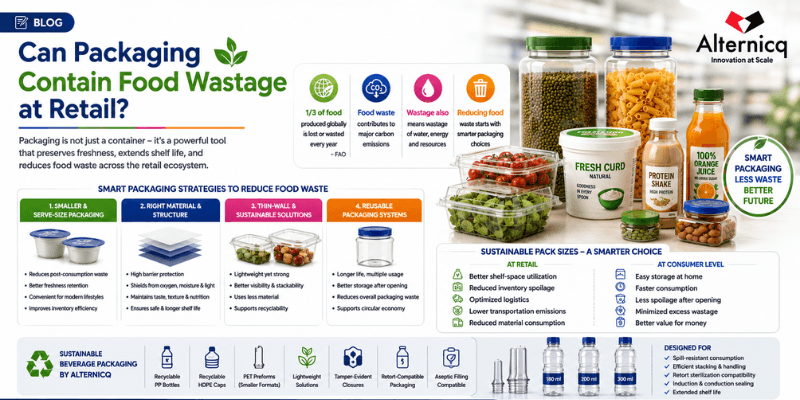
1. Introduce Smaller and Serve-Size Packaging
Single-serve and portion-controlled packaging formats are becoming increasingly important in reducing food wastage.
Smaller packaging formats offer several advantages:
- Reduced post-consumption waste
- Improved freshness retention
- Easier inventory management
- Better stock efficiency at retail
- Enhanced convenience for consumers
- Lower storage requirements
Serve-size packaging also supports evolving urban consumption patterns where consumers increasingly prefer convenience, portability, and controlled consumption.
For products with shorter post-opening shelf life — such as dairy products, juices, frozen foods, and ready-to-drink beverages — smaller pack sizes can significantly reduce wastage.
2. Choose the Right Packaging Material and Structure
Every food product has unique storage and preservation requirements.
Packaging material selection must consider:
- Oxygen barrier requirements
- Moisture sensitivity
- Light protection
- Temperature stability
- Transportation durability
- Product compatibility
High-performance packaging structures help maintain freshness across the product’s journey from manufacturing to retail shelf.
Advanced barrier materials such as:
- Polypropylene (PP)
- High-Density Polyethylene (HDPE)
- PET
- EVOH-based multilayer structures
are increasingly used to improve food preservation and reduce spoilage.
Customized rigid packaging solutions also help ensure product integrity during handling, storage, and transportation.
3. Adopt Thin-Wall and Sustainable Packaging Solutions
Retail-ready fresh produce such as cut fruits, vegetables, and bakery products require packaging that balances convenience with preservation.
Thin-wall rigid containers offer:
- Improved product visibility
- Better storage efficiency
- Lightweight sustainability benefits
- Enhanced stackability
- Improved product protection
Sustainable thin-wall packaging formats can also support recyclability and circular packaging initiatives while reducing overall material consumption.
4. Encourage Reusable Packaging Systems
Reusable packaging plays a significant role in sustainable food packaging ecosystems.
Rigid plastic packaging often has a longer usable lifecycle compared to flexible packaging formats, making it ideal for reuse applications.
Reusable packaging benefits include:
- Extended packaging lifecycle
- Reduced packaging waste
- Improved household storage
- Better protection after opening
- Lower overall environmental impact
Consumers increasingly prefer packaging formats that offer secondary usability and long-term utility beyond the primary product application.
Sustainable Pack Sizes: A Smarter Packaging Strategy
Optimized pack sizing is emerging as one of the most practical approaches to reducing food wastage.
Smaller and sustainable pack sizes help:
At Retail
- Improve shelf-space utilization
- Reduce inventory spoilage
- Optimize logistics efficiency
- Lower transportation emissions
- Reduce material consumption
At Consumer Level
- Improve storage convenience
- Enable faster consumption
- Reduce spoilage after opening
- Minimize excess product wastage
Pack-size optimization also supports brands in achieving sustainability targets while improving affordability and accessibility.
Sustainable Beverage Packaging Innovations
At Alternicq Limited, we continue to innovate in sustainable rigid plastic packaging for the beverage and food industry.
Our packaging portfolio includes:
- Recyclable PP bottles
- Recyclable HDPE caps
- PET preforms for smaller beverage formats
- Lightweight packaging solutions
- Tamper-evident closures
- Retort-compatible packaging systems
We manufacture packaging solutions in multiple fill volumes including:
- 180 ml
- 200 ml
- 300 ml
These packaging solutions are designed for:
- Spill-resistant consumption
- Efficient stacking and handling
- Retort sterilization compatibility
- Induction and conduction sealing
- Extended shelf life applications
Our PET beverage packaging solutions are also compatible with aseptic filling environments and advanced food safety requirements.
The Future of Sustainable Food Packaging
The future of food packaging will increasingly focus on:
- Circular packaging systems
- Recyclable mono-material packaging
- Smart packaging technologies
- Lightweight packaging
- Reusable packaging ecosystems
- PCR-integrated food packaging
- AI-driven packaging optimization
- Shelf-life extension technologies
As food security and sustainability become global priorities, packaging innovation will continue to play a central role in reducing food waste across the value chain.
Frequently Asked Questions
How does packaging reduce food waste?
Packaging reduces food waste by protecting products from oxygen, moisture, contamination, transportation damage, and spoilage while improving shelf life and storage efficiency.
Why are smaller pack sizes important?
Smaller pack sizes reduce post-opening spoilage, improve consumption efficiency, and minimize product wastage at both retail and household levels.
What packaging materials are best for food preservation?
Materials such as PET, PP, HDPE, and EVOH-based multilayer structures offer strong barrier properties that help preserve freshness and extend shelf life.
Is reusable rigid packaging more sustainable?
Yes. Reusable rigid packaging extends packaging lifecycle, improves storage usability, and reduces overall packaging waste when integrated effectively into circular economy systems.
How is Alternicq contributing to sustainable food packaging?
Alternicq Limited develops advanced rigid plastic packaging solutions focused on sustainability, lightweighting, recyclability, shelf-life enhancement, and packaging innovation across food and beverage industries.